Rewire interventions
12 urge interventions for the moment a craving hits
Short, interactive exercises you run when the pull is strongest, instead of white-knuckling it. Each one is built on a technique from cognitive behavioral therapy, mindfulness or inhibitory control research, and each one takes between one and five minutes.
 Download on iOS
What an urge intervention is
An urge does not build forever. It rises, peaks and fades, the idea behind urge surfing in relapse-prevention research. The hardest stretch is the peak, when the pull is loudest and willpower is most likely to fail.
An urge intervention is something specific to do during that stretch. Some work through your body (moving, pressing, relaxing your face). Some occupy your mind (a memory puzzle, a reaction game). Others bring the long term back into view (your values, a letter from your future self). The goal is the same: get through the peak without acting on it.
The research behind the whole system is on the methodology page.
How an intervention runs in Rewire
Tap “I am having an urge” on the home screen and pick the habit pulling at you. Rewire takes it from there, and when the intervention ends you log “I resisted” or “I gave in”. You can also open any intervention straight from the Intervene tab to practise.
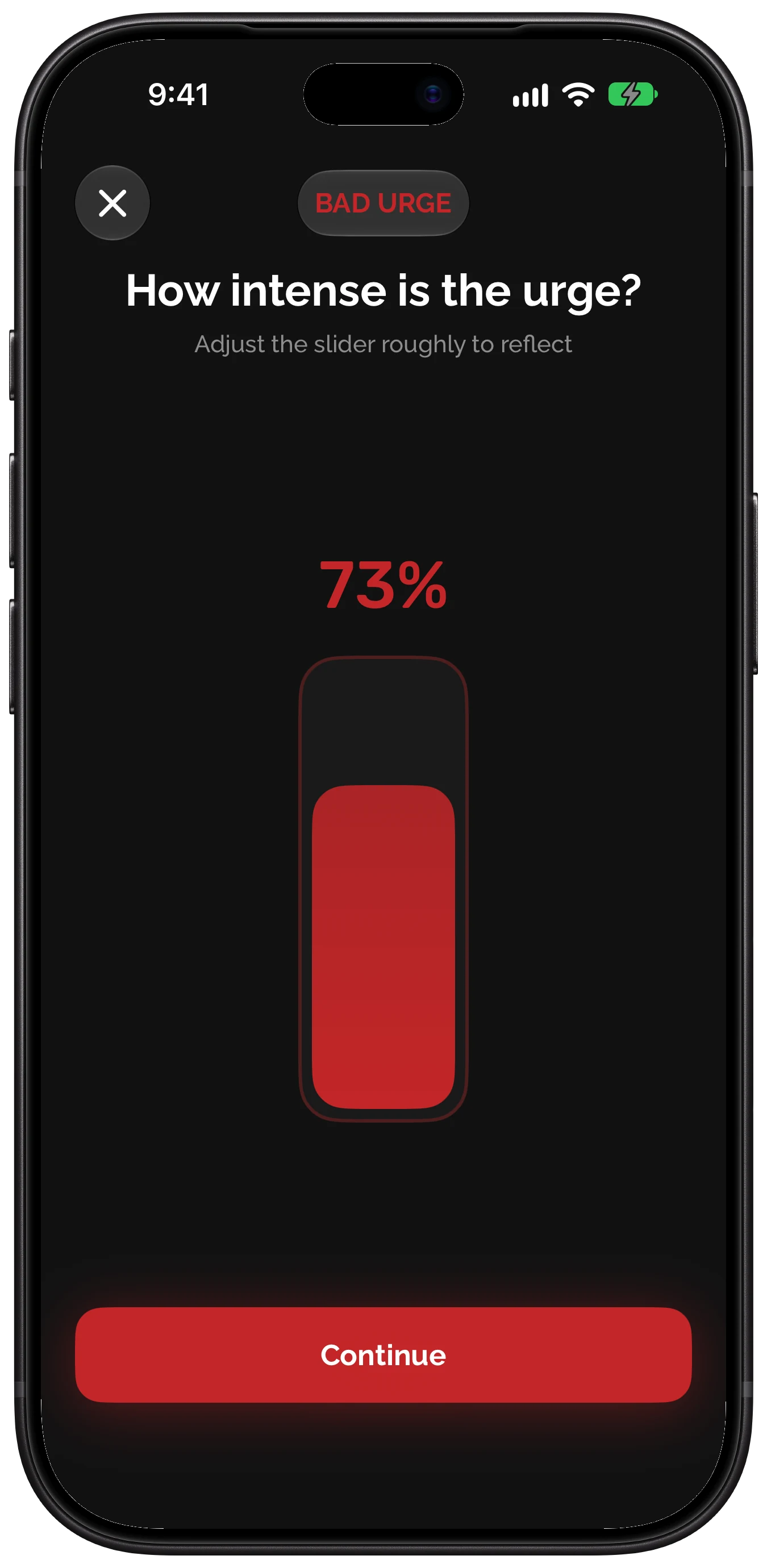 1Rate itSlide to show how strong the urge is right now.
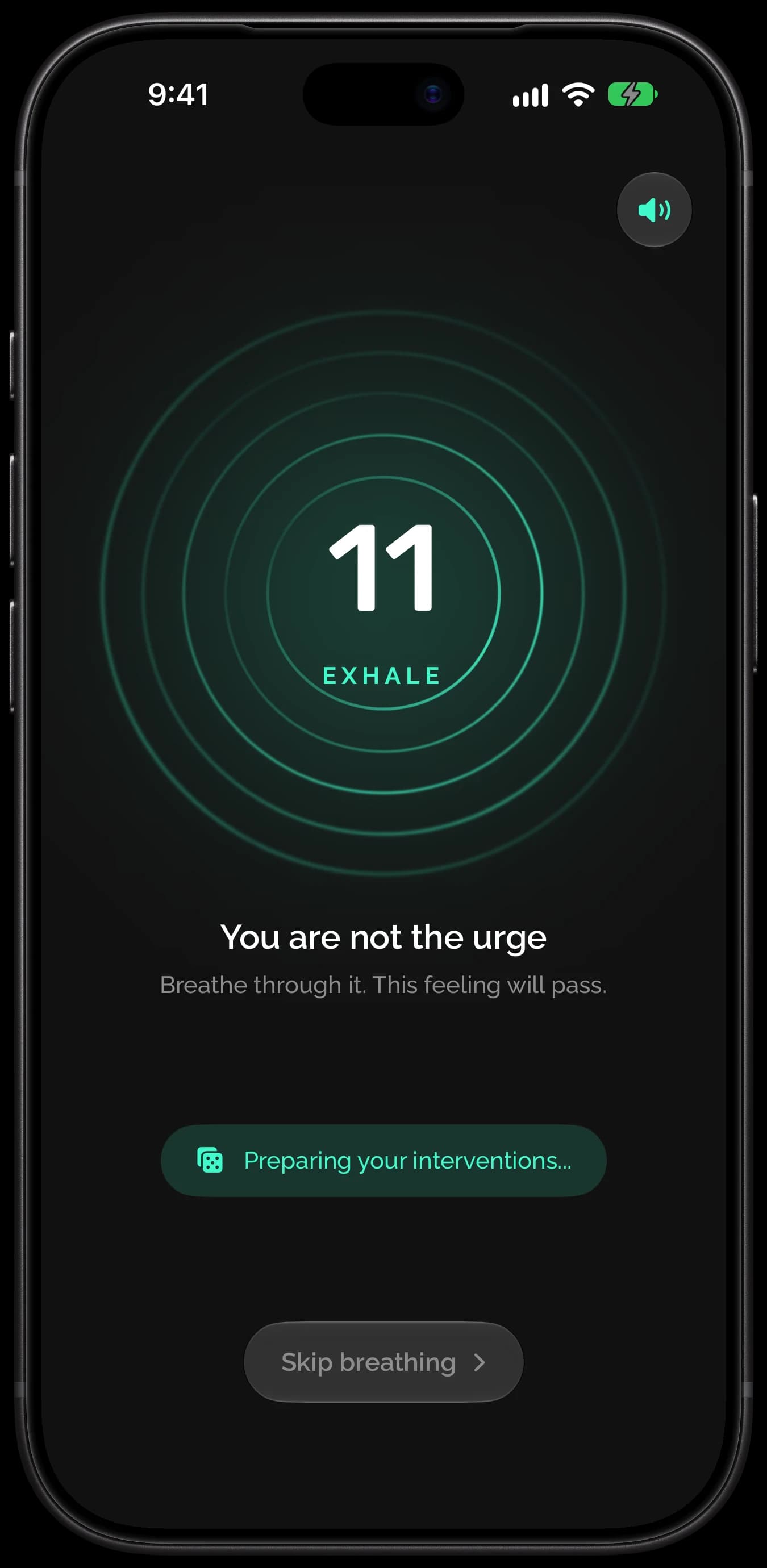 2BreatheFifteen seconds: “Breathe through it. This feeling will pass.”
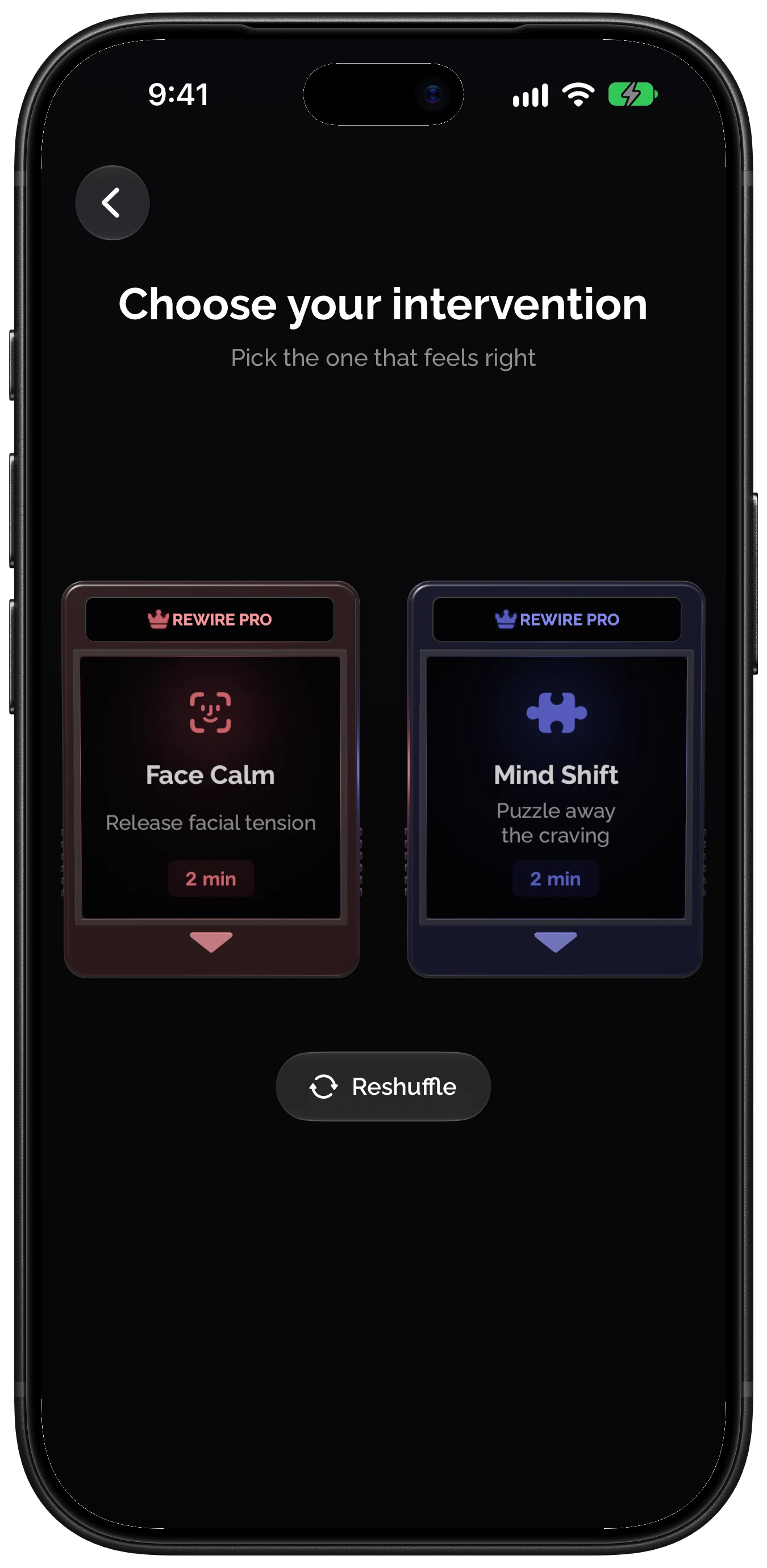 3Choose 1 of 2Two cartridges come up. Pick one, or reshuffle for a new pair.
All 12 interventions
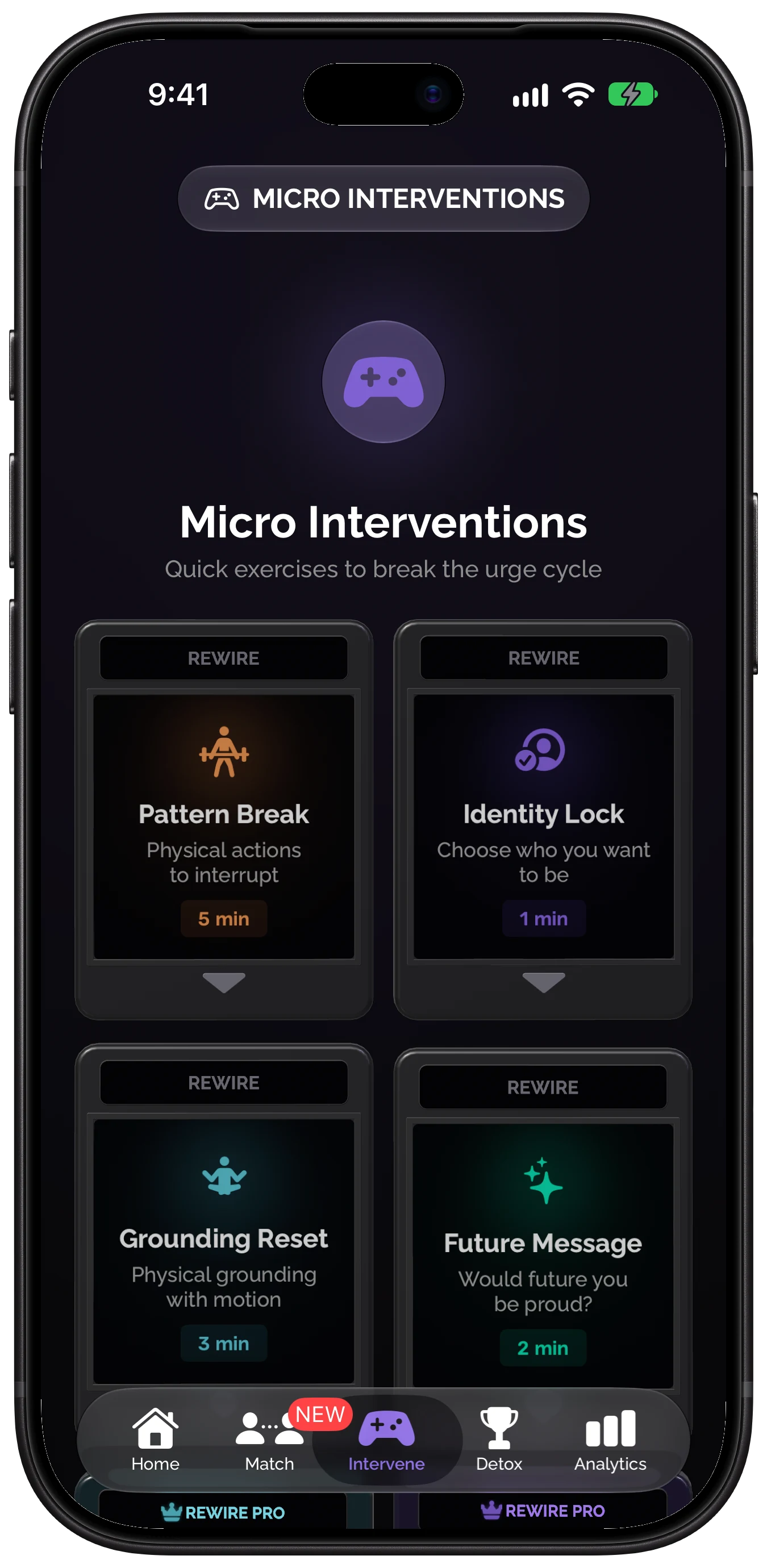
Tap a cartridge to jump to how it works and the research behind it.
Free
Rewire Pro
The 4 free interventions
Included in Rewire at no cost, with no account needed.
01
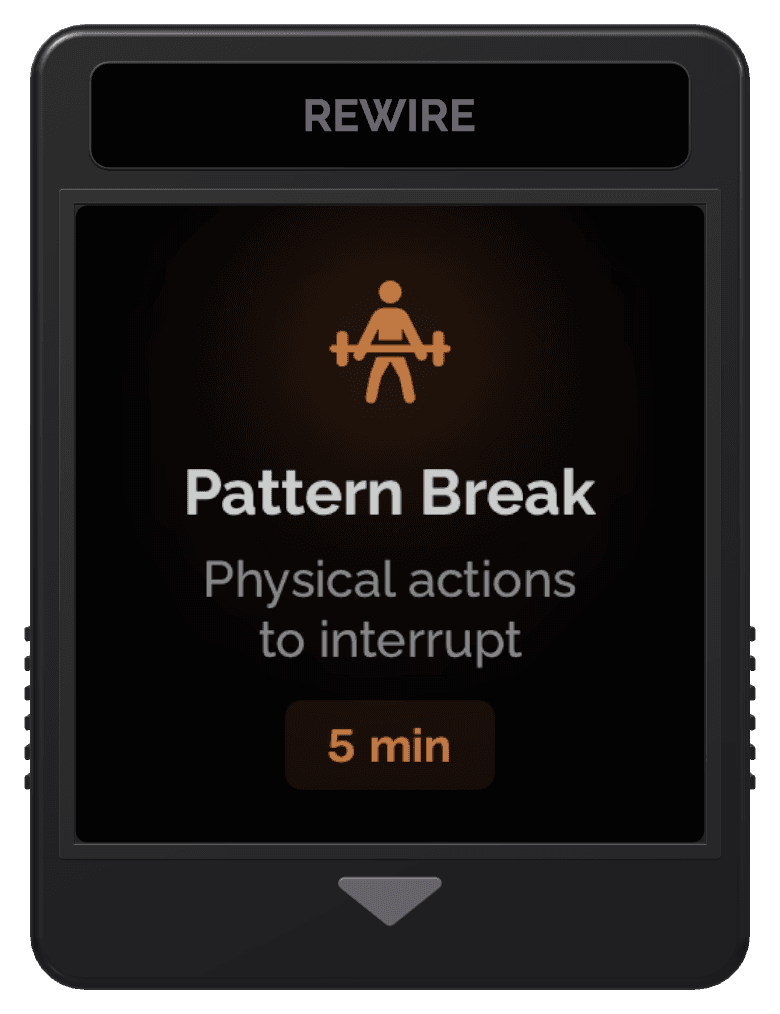
Pattern BreakFree
Pattern Break interrupts an urge with your body instead of your willpower. You get up and run a short physical routine, which breaks the automatic chain between the cue and the habit.
What you do
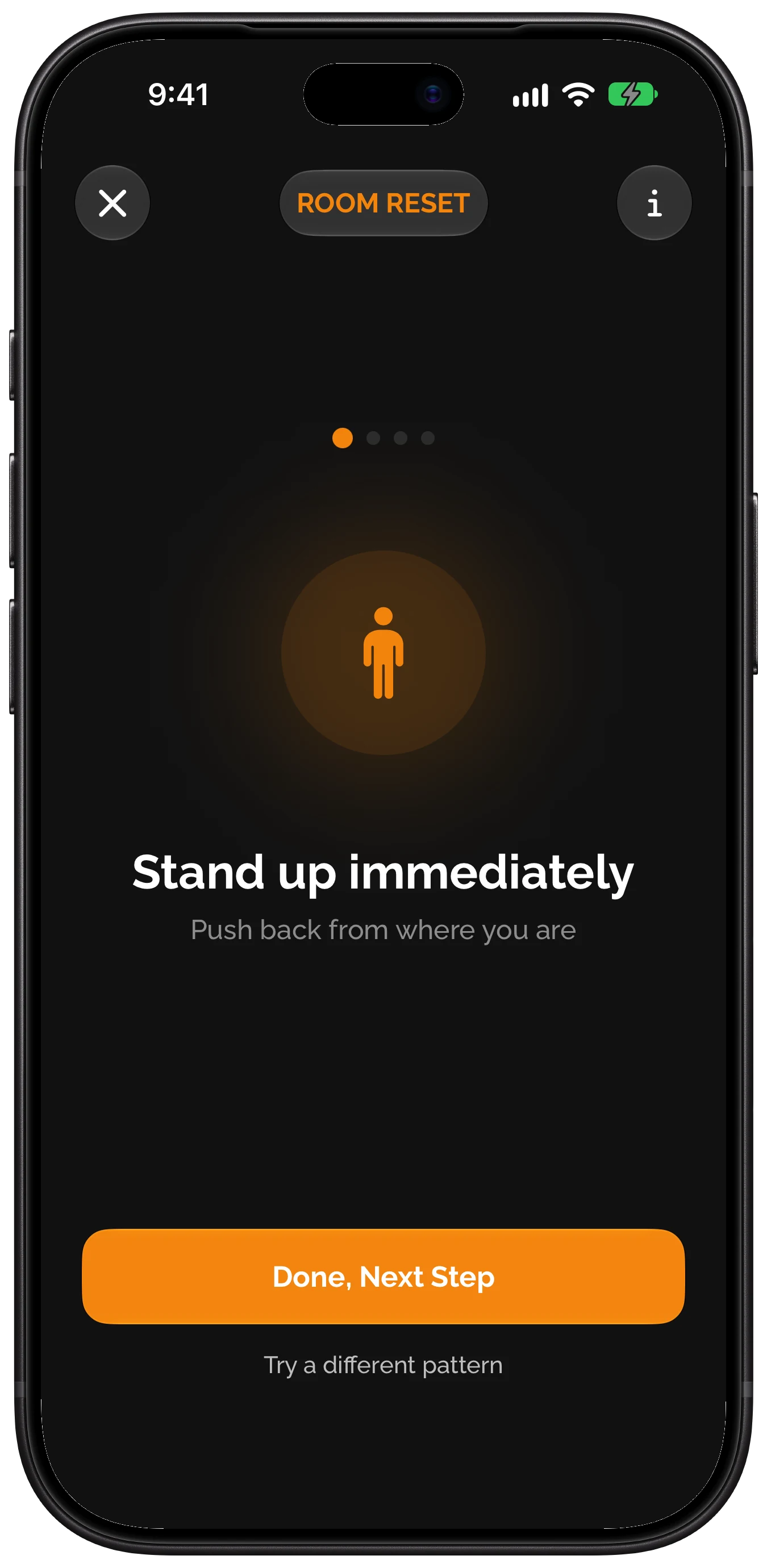
- 1Rewire picks one of three routines: Room Reset, Cold Shock or Fresh Air.
- 2Room Reset: stand up immediately, walk to another room, drink a glass of water, come back and take five deep breaths.
- 3Cold Shock: splash cold water on your face, look at yourself in the mirror and say “I am in control” out loud.
- 4Fresh Air: walk to a window, take five slow breaths, stretch, then leave your phone behind and walk away for two minutes.
- 5Tap “Done, Next Step” as you finish each step, and “Complete Pattern” at the end.
How it ends: “Pattern Complete! You’ve successfully broken the urge cycle.”
Why it works
Pattern interruption (CBT)
Habits run as cue, routine, reward. Changing what you are physically doing, and where you are, breaks the routine at its start, before the automatic part takes over.
- Beck, J. S. (2020). Cognitive Behavior Therapy: Basics and Beyond (3rd ed.). Guilford Press.
- Duhigg, C. (2012). The Power of Habit. Random House.
02
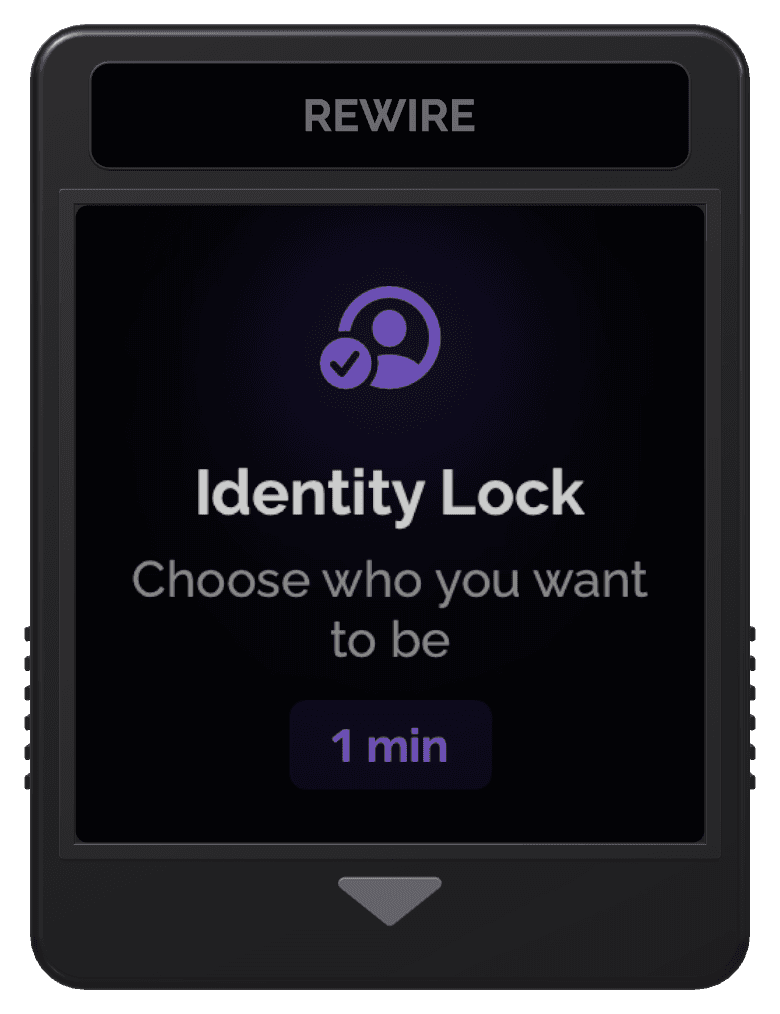
Identity LockFree
Identity Lock turns the urge into a choice about who you are. It is the fastest intervention in Rewire, about a minute from start to finish.
What you do
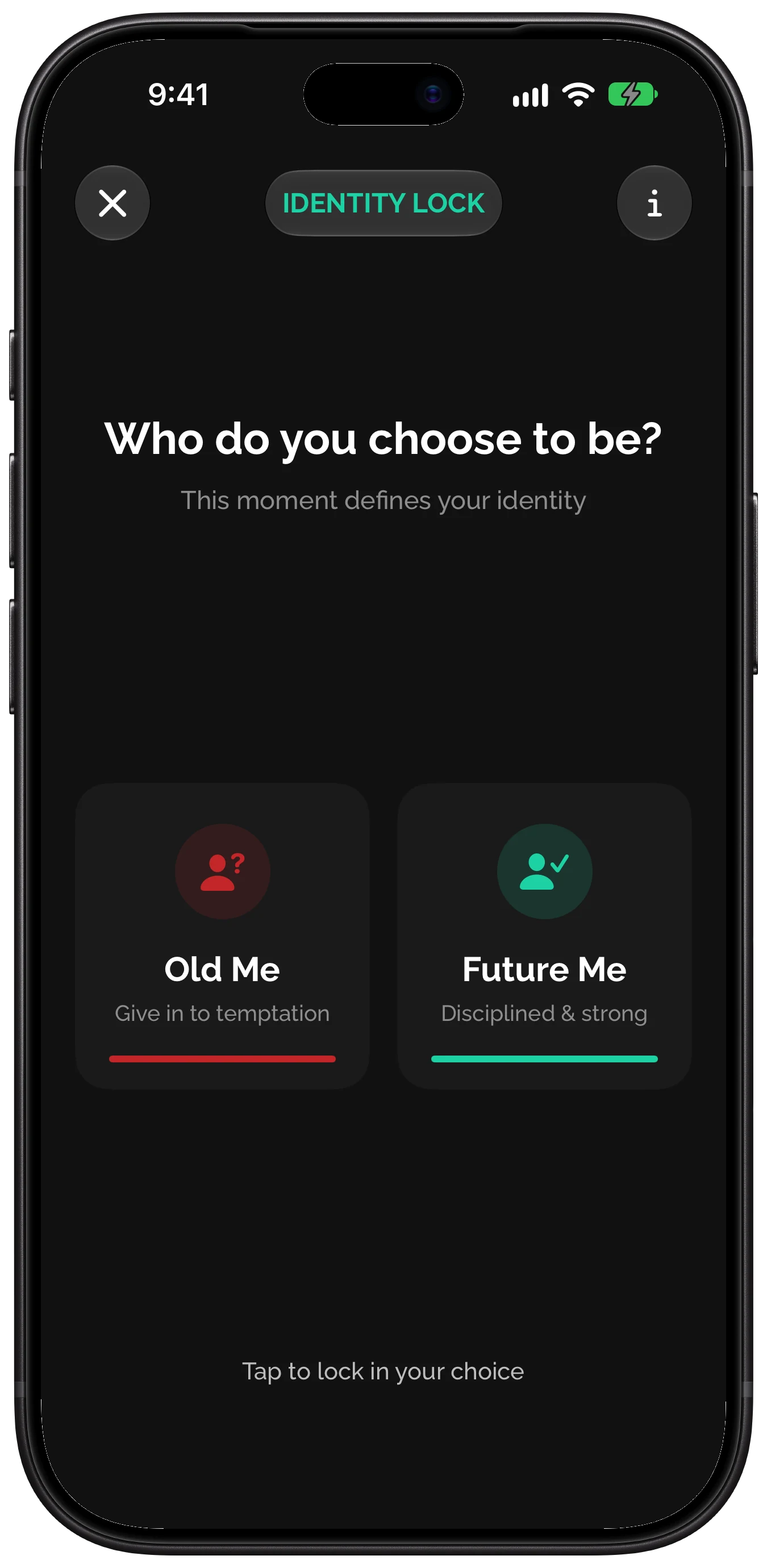
- 1Rewire asks “Who do you choose to be?” and shows two cards: Old Me, “Give in to temptation”, and Future Me, “Disciplined & strong”.
- 2Tap one to lock in your choice.
- 3A short animation plays: “This is who you’re becoming” for Future Me, or “This is not who you are...” for Old Me.
How it ends: Choosing Future Me ends on “Identity Locked: You’ve reinforced your future self.”
Why it works
Identity-based behavior change
People infer who they are from what they do. Framing the moment as a vote for the person you want to be ties one small choice to a bigger self-image, which makes saying no easier.
- Clear, J. (2018). Atomic Habits. Avery.
- Fogg, B. J. (2009). A behavior model for persuasive design. Proceedings of the 4th International Conference on Persuasive Technology. doi:10.1145/1541948.1541999
03
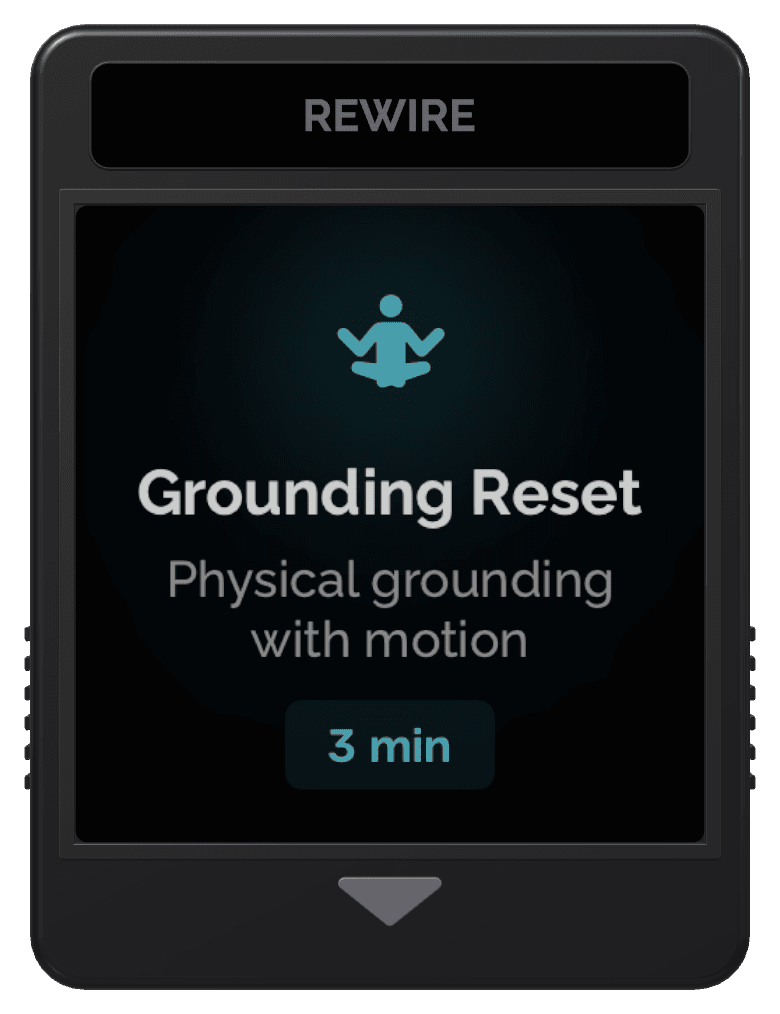
Grounding ResetFree
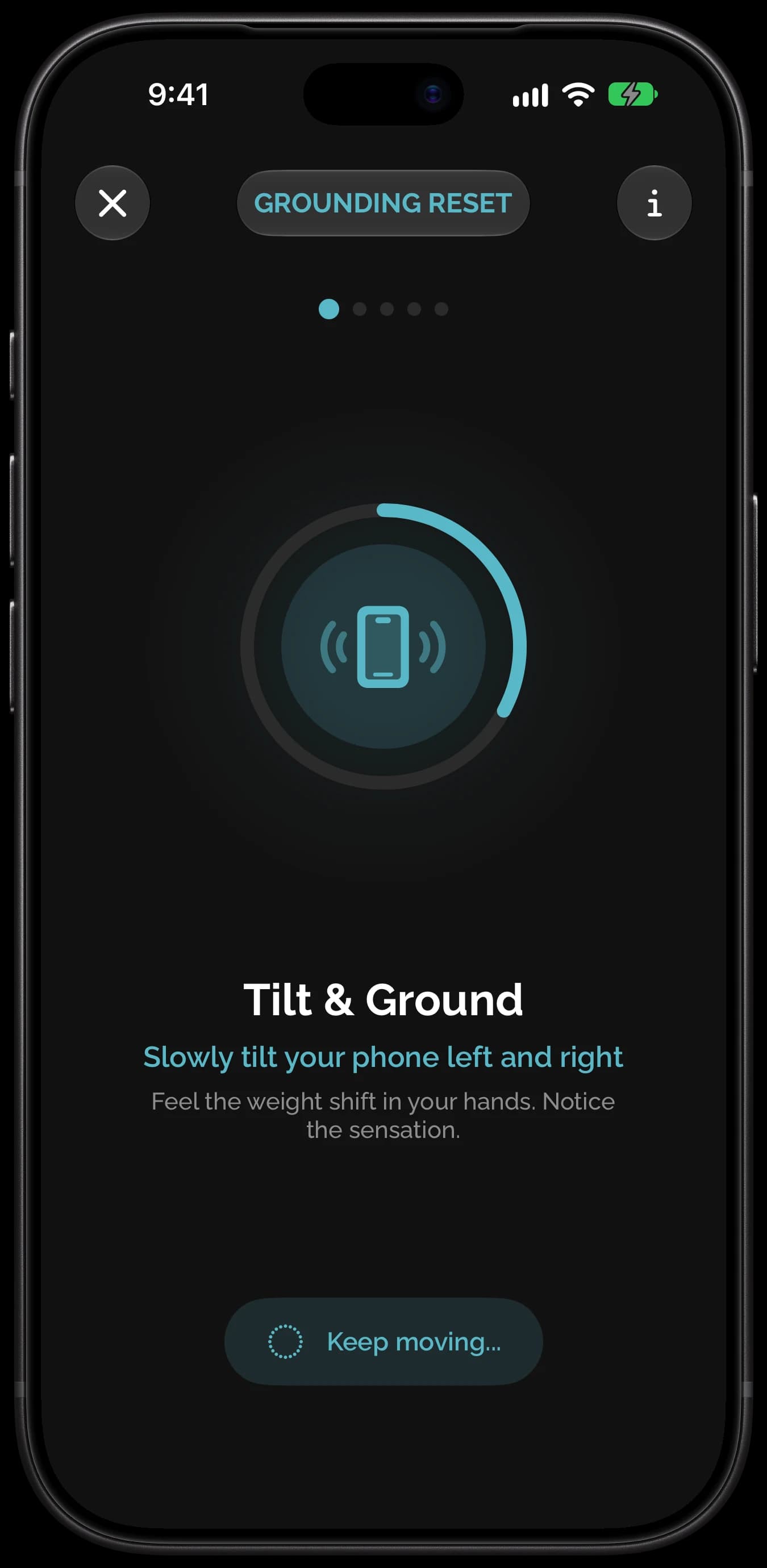
Grounding Reset uses slow, deliberate movement to pull your attention out of the craving and back into your body and the room around you.
What you do
- 1Tilt & Ground: slowly tilt your phone left and right.
- 2Lift & Notice: raise your phone up, then down slowly.
- 3Rotate & Breathe: gently rotate your phone clockwise.
- 4Shake & Release: give your phone a gentle shake.
- 5Still & Present: hold completely still for five seconds. Each step fills a ring from the motion sensors, so you cannot rush it.
How it ends: “You’re Grounded: You’ve reconnected with the present moment.”
Why it works
Grounding (CBT)
Grounding exercises are used in CBT and anxiety care to move attention from distressing thoughts to physical sensation in the present moment. Pairing each step with movement, and then stillness, gives the urge something concrete to compete with.
- Beck, J. S. (2020). Cognitive Behavior Therapy: Basics and Beyond (3rd ed.). Guilford Press.
- Anxiety & Depression Association of America (ADAA), grounding techniques.
04
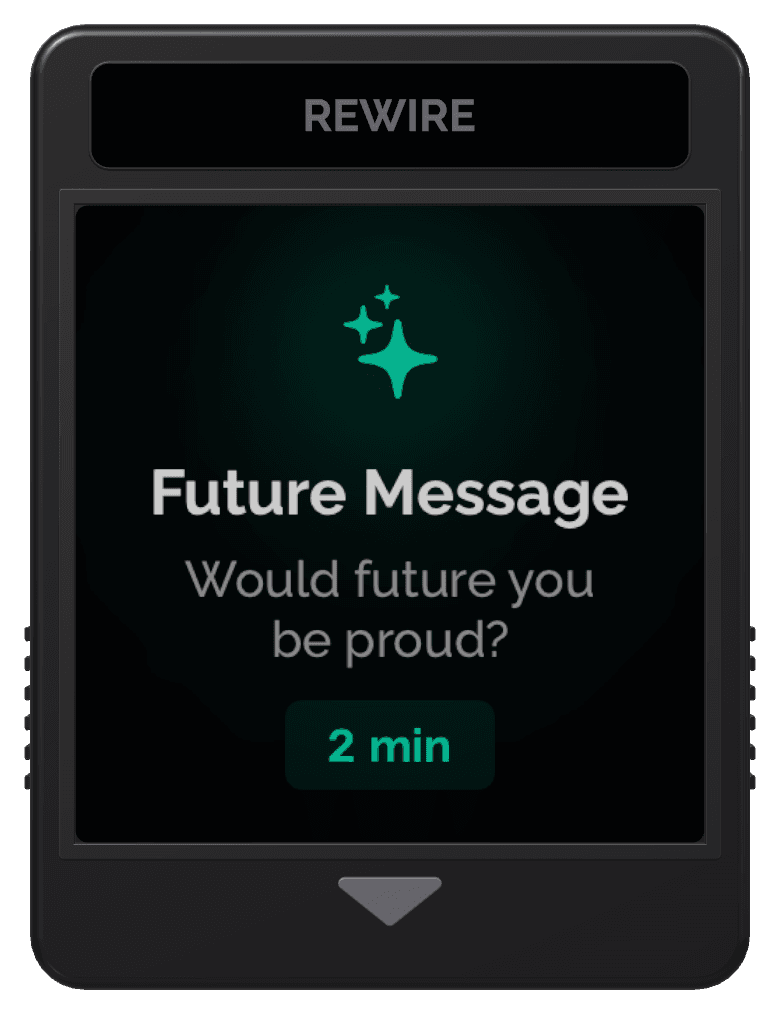
Future MessageFree
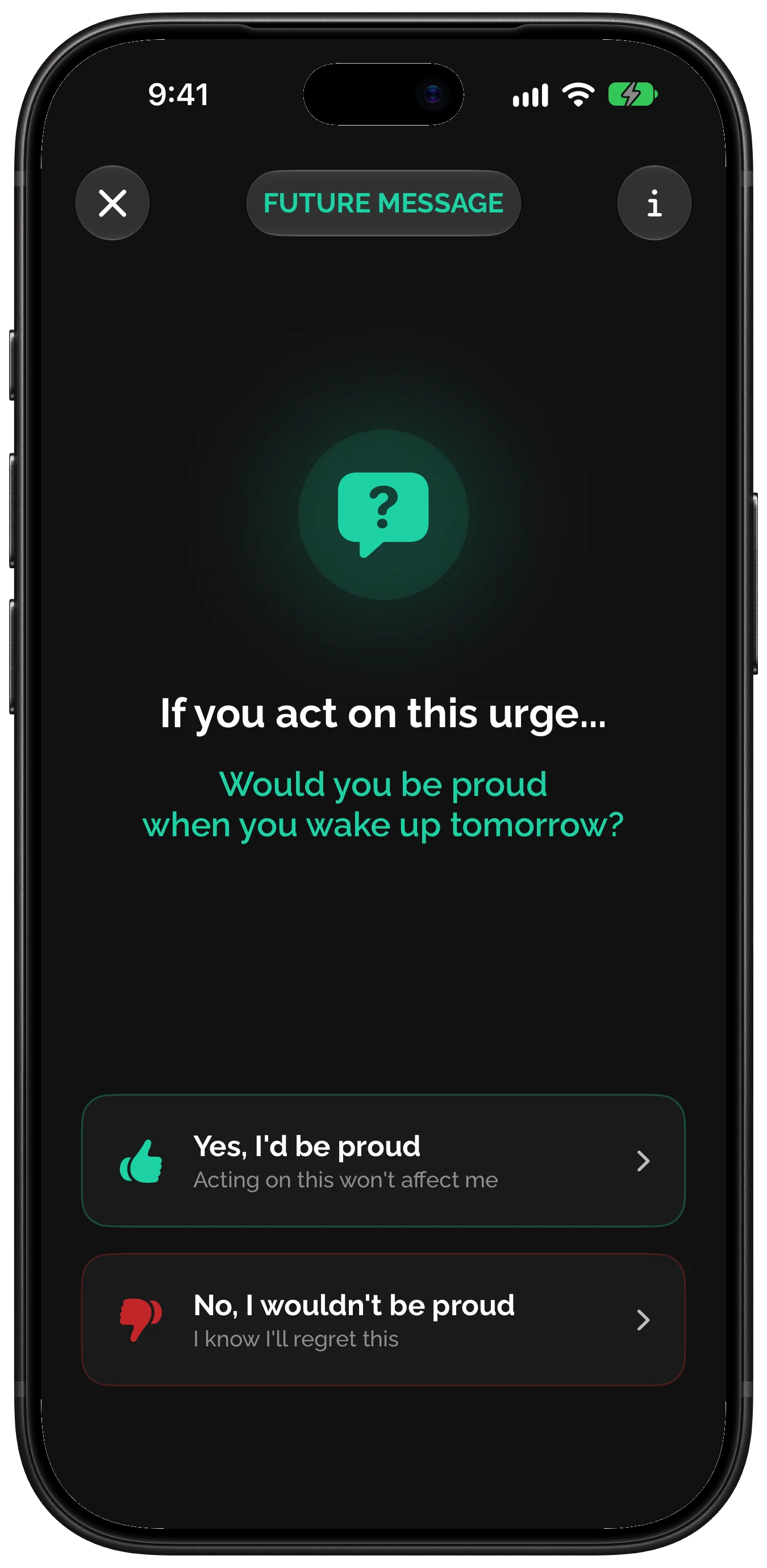
Future Message asks one question at the moment of the urge: would you be proud of this when you wake up tomorrow?
What you do
- 1Three short screens slow you down: “Take a deep breath right now”, “Imagine waking up tomorrow”, “You look back at this moment”.
- 2Rewire asks: “If you act on this urge... would you be proud when you wake up tomorrow?”
- 3Answer “Yes, I’d be proud” or “No, I wouldn’t be proud”.
How it ends: Answering no ends on “Clarity Achieved: You already know the right choice.” Answering yes asks you to reconsider whether this fits your goals.
Why it works
Motivational interviewing (decisional balance)
Urges win when only the next few minutes count. Picturing tomorrow morning brings the longer-term cost into view at the moment of choice, and switches you into the slower, deliberate kind of thinking that impulses skip.
- Miller, W. R., & Rollnick, S. (2013). Motivational Interviewing: Helping People Change (3rd ed.). Guilford Press.
- Kahneman, D. (2011). Thinking, Fast and Slow. Farrar, Straus and Giroux.
The 8 Pro interventions
Part of Rewire Pro, for when you want more ways through an urge: games that train your stop reflex, exercises that use your camera and your fingers, and tools built from your own words.
05
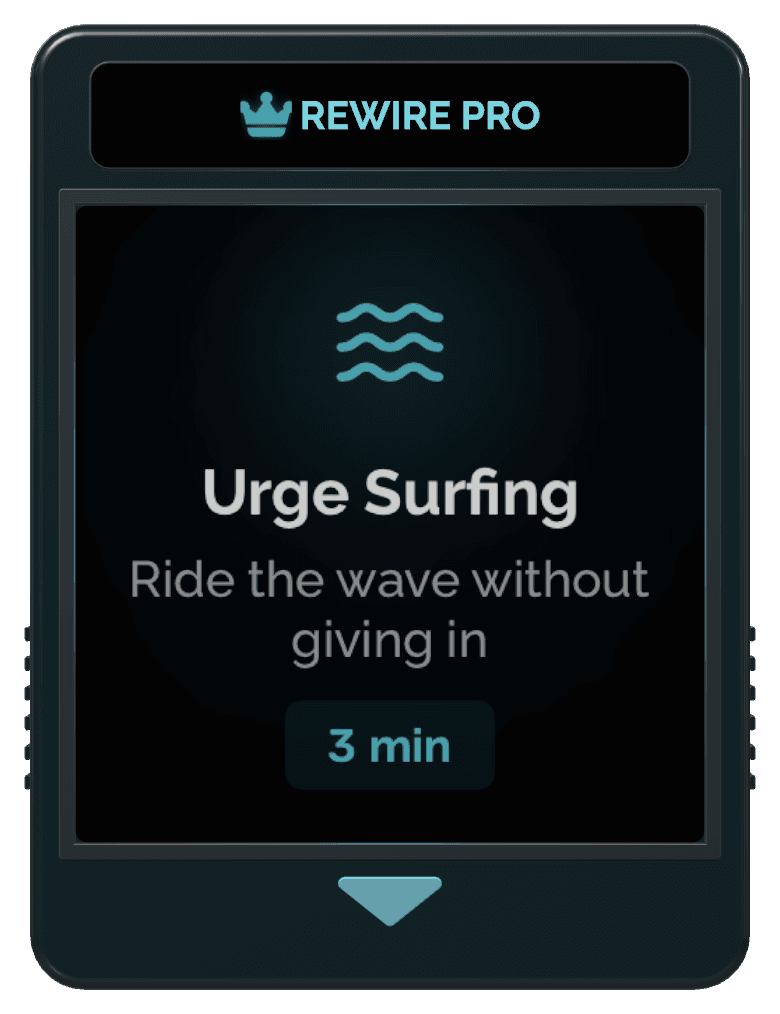
Urge SurfingPro
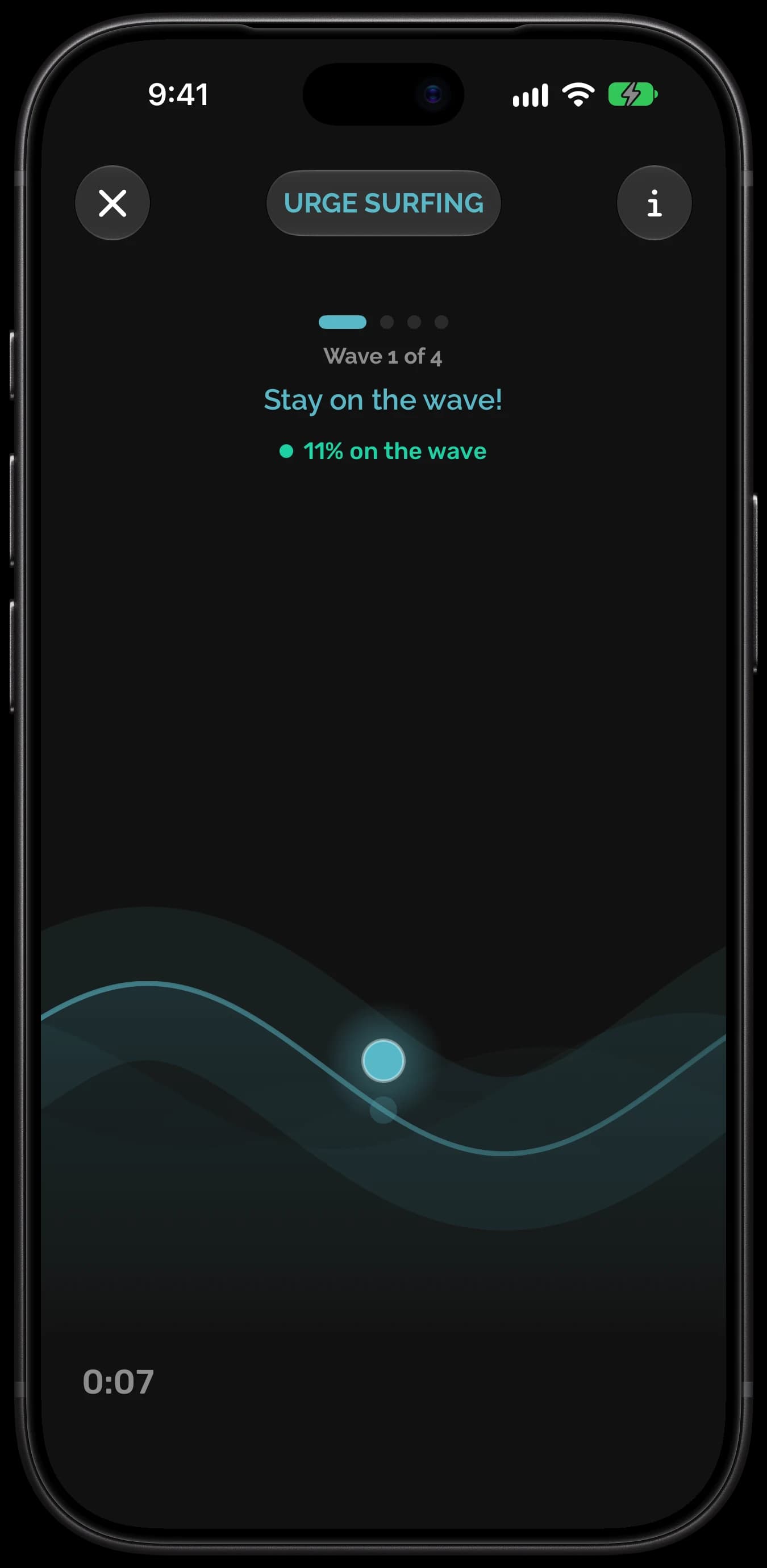
Urge Surfing teaches you to ride an urge out instead of fighting it or giving in. You trace a moving wave with your finger as it rises, peaks and fades.
What you do
- 1Touch and drag to keep a dot on a moving wave. It glows teal on the wave and turns red when you slip off.
- 2Each wave has three phases: “The wave is building...”, “Stay on the wave!”, “The urge is fading...”.
- 3Surf four waves, each taller and faster than the last. A live readout shows how much of the time you stayed on the wave.
How it ends: “Waves Surfed!”, with your time, waves and accuracy.
Why it works
Mindfulness-based relapse prevention
Urge surfing comes from Alan Marlatt’s relapse-prevention work: notice the craving as a wave that rises, peaks and passes, without acting on it. In a randomized study, college student smokers given brief urge-surfing instructions smoked fewer cigarettes over the following week than a control group (Bowen & Marlatt, 2009).
- Marlatt, G. A., & Donovan, D. M. (2005). Relapse Prevention (2nd ed.). Guilford Press.
- Bowen, S., & Marlatt, G. A. (2009). Surfing the urge: Brief mindfulness-based intervention for college student smokers. Psychology of Addictive Behaviors, 23(4), 666 to 671. doi:10.1037/a0017127
06
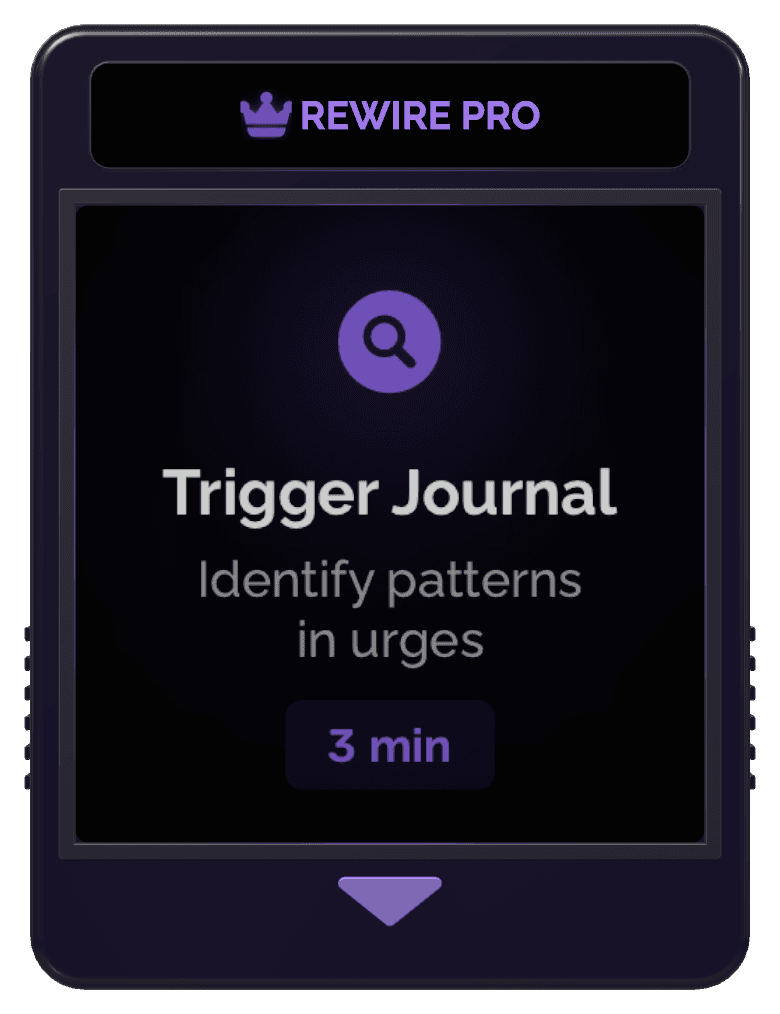
Trigger JournalPro
Trigger Journal logs what was going on right before the urge, so the pattern behind your urges becomes visible.
What you do
- 1How were you feeling? Bored, Stressed, Lonely, Tired, Anxious, Frustrated, Sad or Restless.
- 2Where were you? Home, Work, Bed, Commute, Social or Outside.
- 3What were you doing? Scrolling phone, Working, Watching TV, Lying in bed, After eating, Procrastinating, and more.
- 4Tap “Log Trigger”. It is saved with the habit you were fighting.
How it ends: “Trigger Logged!” Once you have logs from the past week, it points out your most common emotional state.
Why it works
Thought and emotion tracking (CBT)
Self-monitoring is a core CBT tool: you cannot change a pattern you cannot see. Three taps capture the feeling, the place and the activity, the context cues that habits are triggered by.
- Beck, J. S. (2020). Cognitive Behavior Therapy: Basics and Beyond (3rd ed.). Guilford Press.
- Wood, W., & Rünger, D. (2016). Psychology of Habit. Annual Review of Psychology, 67, 289 to 314. doi:10.1146/annurev-psych-122414-033417
07
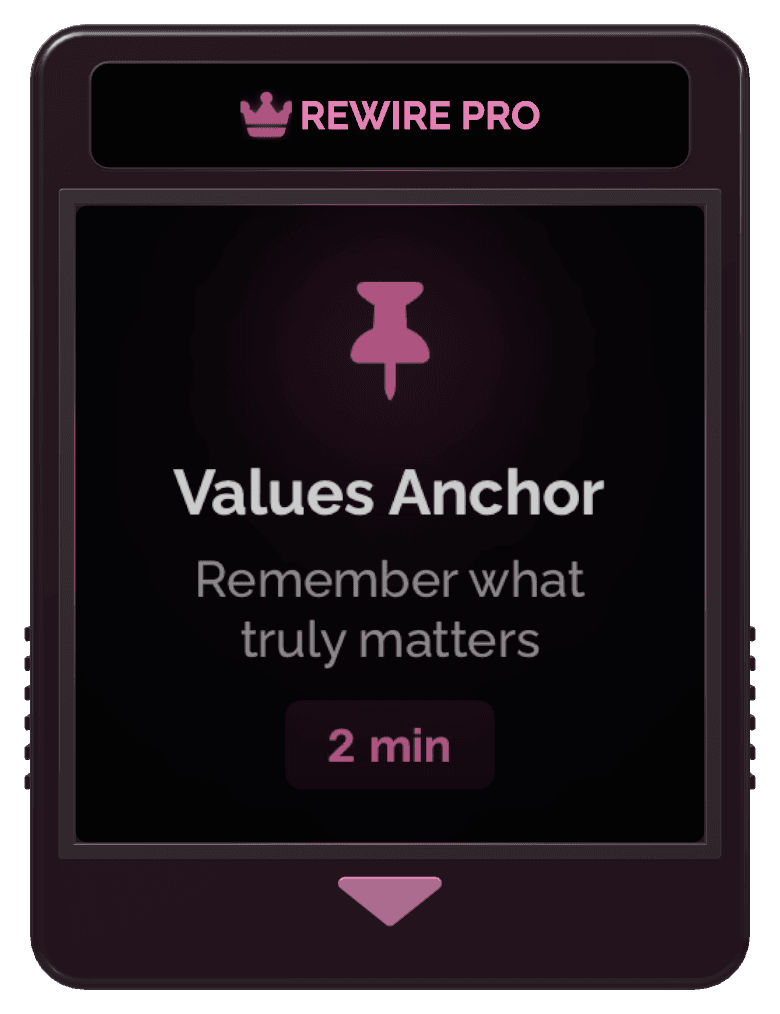
Values AnchorPro
Values Anchor reminds you what matters to you, in your own words, when an urge is trying to make you forget.
What you do
- 1The first time, set up three values. Pick from suggestions like Family, Health, Freedom or Growth, or write your own, and add why each one matters to you.
- 2After that, each run reveals your values one at a time, with your own reasons.
- 3Redefine your values whenever they change.
How it ends: “Anchored: Your values remain unchanged. This urge will pass.”
Why it works
Values clarification (Acceptance and Commitment Therapy)
ACT treats an urge as a passing experience you can make room for while still acting on what you care about. Reading your own reasons, rather than a generic quote, makes the longer-term stakes personal.
- Hayes, S. C., Strosahl, K. D., & Wilson, K. G. (2012). Acceptance and Commitment Therapy: The Process and Practice of Mindful Change (2nd ed.). Guilford Press.
08
Future LetterPro
Future Letter is a letter you write to yourself once, which Rewire hands back to you in the moments you need it most. In the app it opens as “A Letter From Tomorrow”.
What you do
- 1The first time, write a letter to yourself. Prompts like “When you feel this urge, remember...” and “The life we’re building looks like...” help you start.
- 2Seal it. From then on, an urge brings a sealed envelope: “A Letter From Tomorrow”.
- 3Open it and read your own words, from your future self.
- 4Write a new letter whenever you want to.
How it ends: “Message Received: Your future self is cheering for you. Make them proud.”
Why it works
Future-self continuity
People who feel more connected to their future selves tend to make more patient, long-term choices (Hershfield, 2011), and a weaker sense of connection to the future self is linked to more impatient spending (Bartels & Urminsky, 2011). A letter in your own voice makes that future self concrete.
- Hershfield, H. E. (2011). Future self-continuity: How conceptions of the future self transform intertemporal choice. Annals of the New York Academy of Sciences, 1235, 30 to 43. doi:10.1111/j.1749-6632.2011.06201.x
- Bartels, D. M., & Urminsky, O. (2011). On intertemporal selfishness: How the perceived instability of identity underlies impatient consumption. Journal of Consumer Research, 38(1), 182 to 198. doi:10.1086/658339
09
Mind ShiftPro
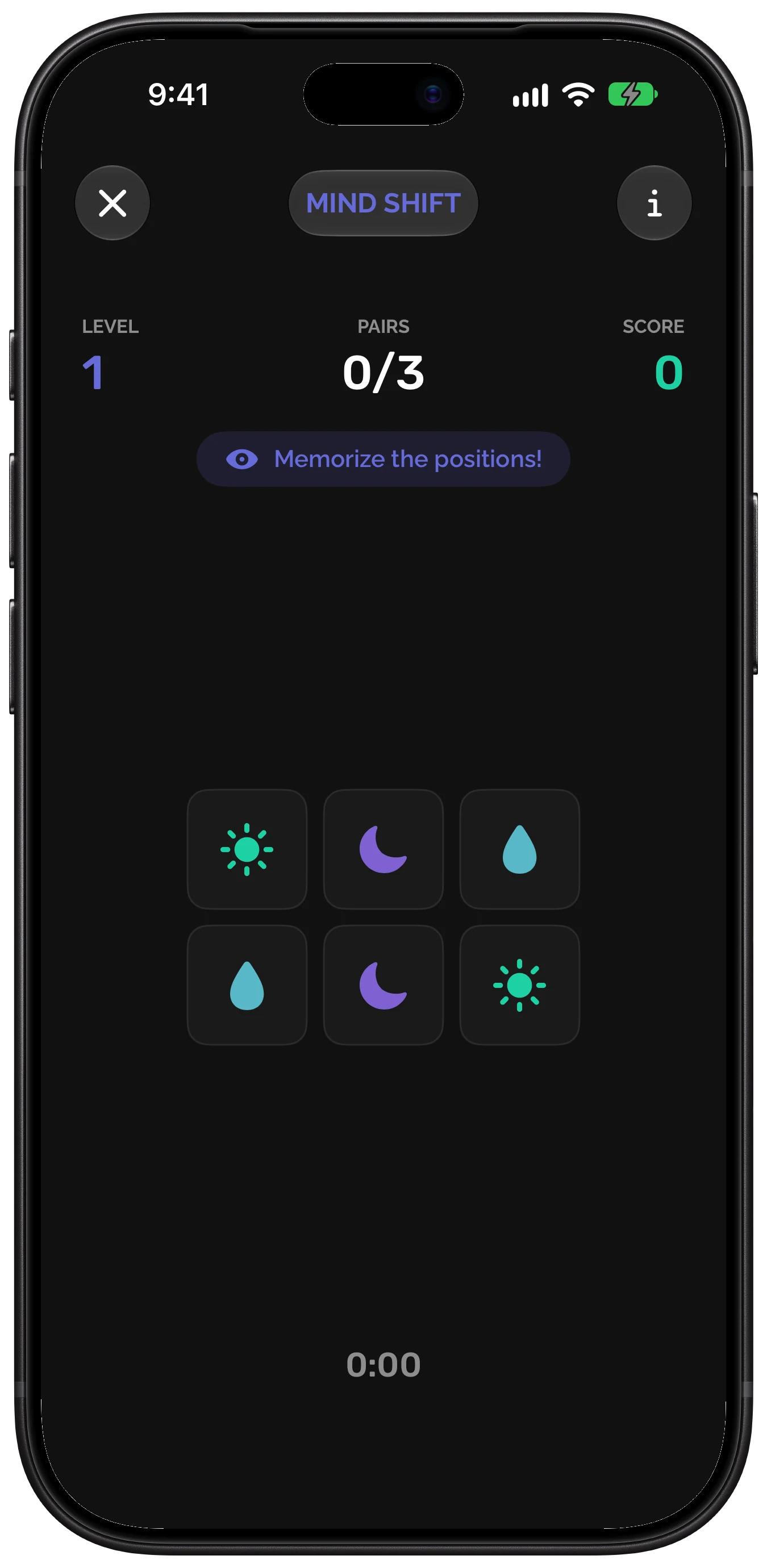
Mind Shift is a memory puzzle that keeps your working memory too busy to hold on to the craving.
What you do
- 1All the cards show face up for a moment. Memorise where each symbol is.
- 2They flip over, and you tap to find the matching pairs.
- 3Five levels, from 3 pairs up to 8, with less time to memorise as you go.
How it ends: “Mind Shifted! Your working memory was too busy for cravings.”
Why it works
Working memory load
Cravings are built partly from vivid mental imagery (Kavanagh, Andrade & May, 2005). A visual task competes for the same mental resources, and in a field study, playing Tetris for a few minutes reduced the strength of everyday cravings (Skorka-Brown et al., 2015).
- Kavanagh, D. J., Andrade, J., & May, J. (2005). Imaginary relish and exquisite torture: The elaborated intrusion theory of desire. Psychological Review, 112(2), 446 to 467. doi:10.1037/0033-295X.112.2.446
- Skorka-Brown, J., Andrade, J., Whalley, B., & May, J. (2015). Playing Tetris decreases drug and other cravings in real world settings. Addictive Behaviors, 51, 165 to 170. doi:10.1016/j.addbeh.2015.07.020
10
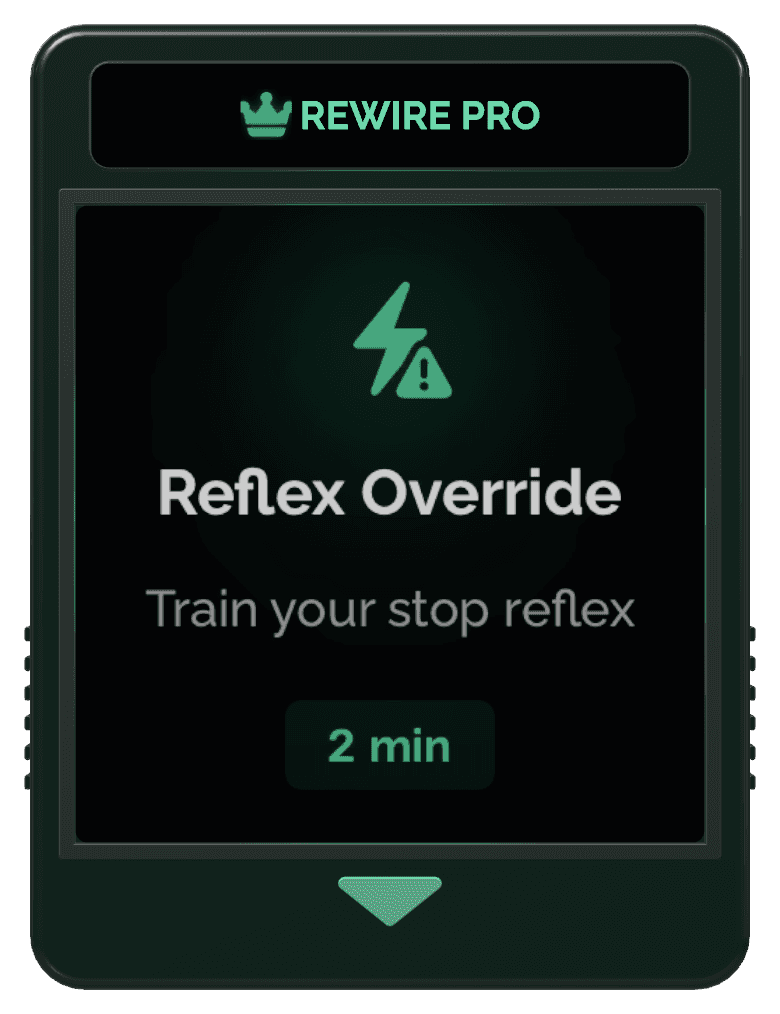
Reflex OverridePro
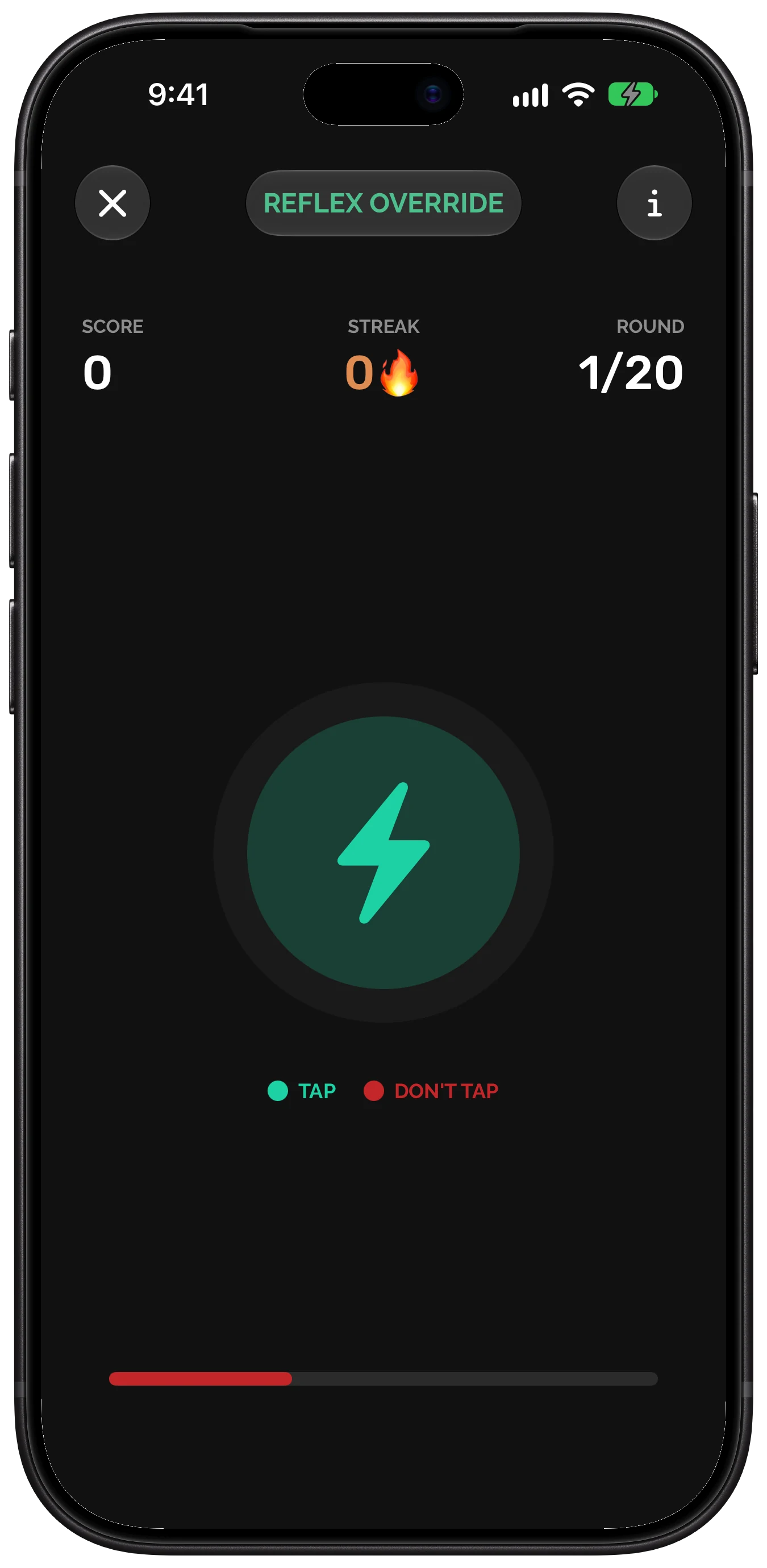
Reflex Override is a fast reaction game that trains your brain to stop an automatic response, the same reflex an urge relies on.
What you do
- 1Tap the green symbols, like a leaf, a heart or a star.
- 2Don’t tap the red ones, like an X, a warning sign or a raised hand.
- 3Twenty rounds, with each symbol on screen for 1.5 seconds. Holding back on a red symbol scores more than tapping a green one, and streaks add bonus points.
How it ends: “Reflexes Trained!”, with your score, accuracy and best streak.
Why it works
Inhibitory control training
This is a go/no-go task, the family of exercises researchers use to study and train response inhibition. A meta-analysis found that inhibitory control training reduced eating and drinking of the targeted foods and alcohol in laboratory studies (Jones et al., 2016).
- Verbruggen, F., & Logan, G. D. (2008). Response inhibition in the stop-signal paradigm. Trends in Cognitive Sciences, 12(11), 418 to 424. doi:10.1016/j.tics.2008.07.005
- Jones, A., et al. (2016). Inhibitory control training for appetitive behaviour change: A meta-analytic investigation of mechanisms of action and moderators of effectiveness. Appetite, 97, 16 to 28. doi:10.1016/j.appet.2015.11.013
11
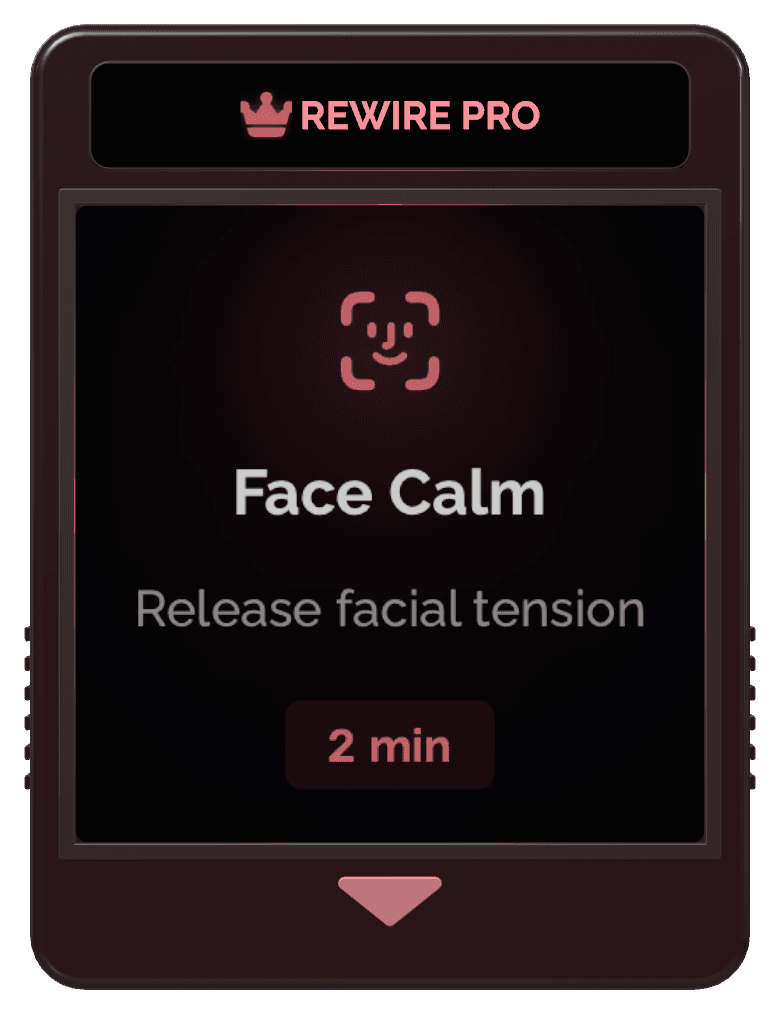
Face CalmPro
Face Calm uses your iPhone’s front camera to coach your face out of tension, one step at a time, with live feedback.
What you do
- 1Allow camera access. Processing happens on your iPhone, and no images are captured or stored.
- 2Follow four steps: Unclench Your Jaw, Smooth Your Brow, Soften Your Eyes and Gentle Half-Smile.
- 3A Tense to Calm bar and a progress ring react live. Hold the relaxed expression to fill the ring. Tense up and it drains.
How it ends: “Tension Released: Your face told your brain to calm down.”
Why it works
Facial feedback and progressive muscle relaxation
Relaxing one muscle group at a time is the core of Jacobson’s progressive relaxation. A 2022 multi-lab study found that facial expressions have a small but reliable effect on how people feel (Coles et al., 2022).
- Coles, N. A., et al. (2022). A multi-lab test of the facial feedback hypothesis. Nature Human Behaviour, 6, 1731 to 1742. doi:10.1038/s41562-022-01458-9
- Jacobson, E. (1938). Progressive Relaxation. University of Chicago Press.
12
Pressure ReleasePro
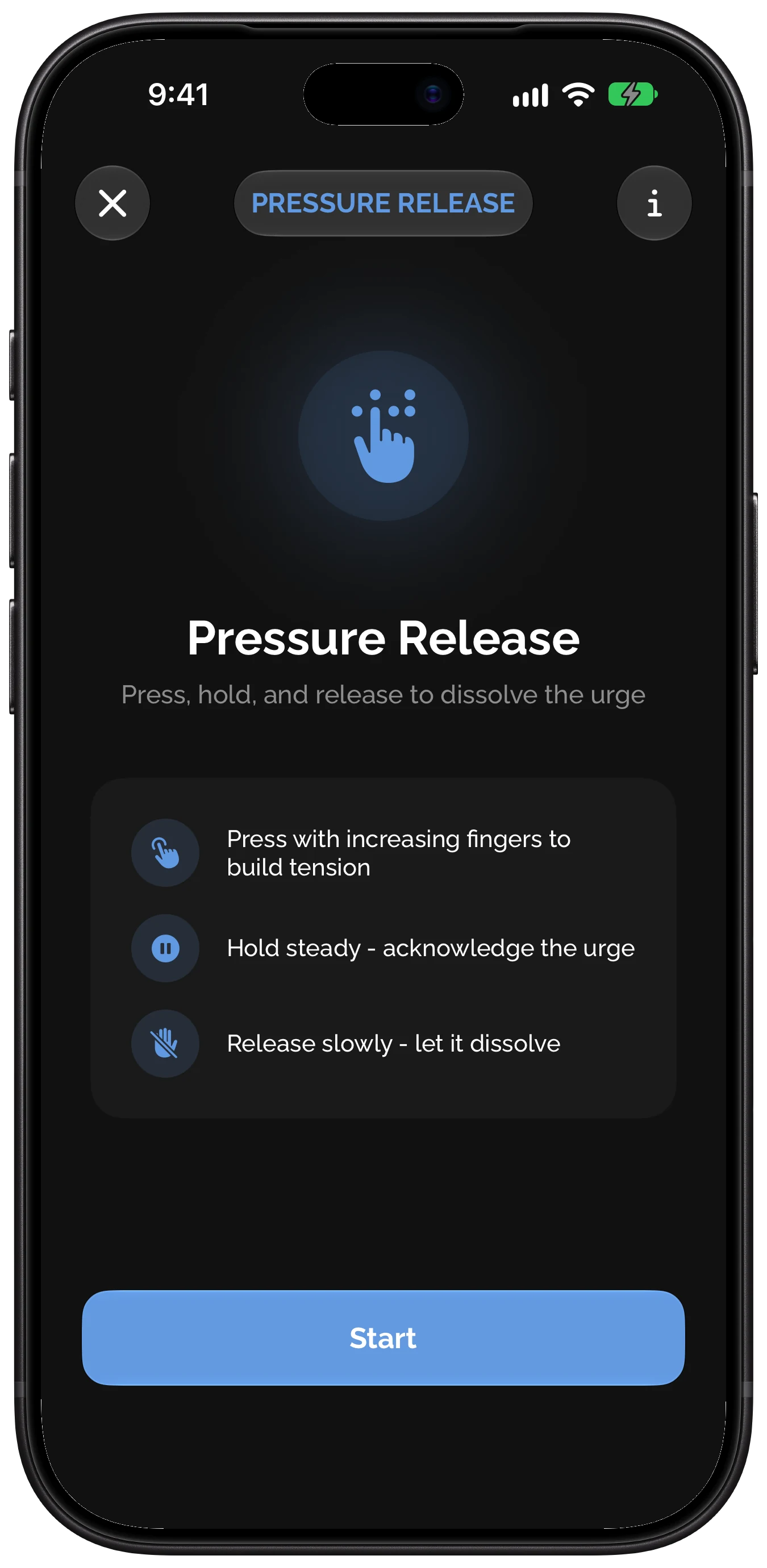
Pressure Release turns the urge into tension you can hold in your fingers, and then let go of.
What you do
- 1Press down with your fingers: “Feel the tension build. This is the urge.”
- 2Hold for five seconds while a heartbeat pulse plays. Lift early and the hold resets.
- 3Let go slowly, one finger at a time, then breathe.
- 4Four rounds, from two fingers up to five.
How it ends: “Tension Released: You held the urge and chose to let it go.”
Why it works
Progressive muscle relaxation and DBT distress tolerance
Deliberately tensing and then releasing muscles lowers physical arousal, the idea behind progressive muscle relaxation. TIPP, a distress-tolerance skill set from dialectical behavior therapy, includes paired muscle relaxation for intense moments.
- Jacobson, E. (1938). Progressive Relaxation. University of Chicago Press.
- Linehan, M. M. (2015). DBT Skills Training Manual (2nd ed.). Guilford Press.
Which intervention should you pick?
There is no single best one. These are good starting points, matched to what each exercise is designed for. In the urge flow Rewire offers two at a time, and you can reshuffle.
- Restless, wired, can’t sit stillPattern BreakPressure Release
- Anxious or overwhelmedGrounding ResetFace Calm
- Loud, looping craving thoughtsMind ShiftUrge Surfing
- Your hand moved before you decidedReflex Override
- You know it’s a bad idea and want it anywayFuture MessageFuture LetterValues Anchor
- It keeps happening at the same time or placeTrigger Journal
- It feels like a test of who you areIdentity Lock
- Bored, killing timeMind ShiftPattern Break
Urge intervention FAQ
What is an urge intervention?
A short, structured activity you do at the moment an urge peaks, instead of acting on it or relying on willpower alone. Rewire has 12, each between one and five minutes long, built on techniques from cognitive behavioral therapy, mindfulness-based relapse prevention, acceptance and commitment therapy, and inhibitory control research.
Which Rewire interventions are free?
Four are free: Pattern Break, Identity Lock, Grounding Reset and Future Message. The other eight come with Rewire Pro.
Do urges really pass on their own?
Urges tend to rise, peak and fade rather than build forever, which is the idea behind urge surfing (Marlatt & Donovan, 2005). How long one lasts varies by person and habit, so each intervention is built to carry you through the peak.
Can I do these without the app?
Several, yes. You can run a Pattern Break routine, read your own list of values or write a letter to your future self on paper. Rewire adds the timing and structure, motion and camera feedback for some exercises, and a log of every urge you resist.
Do I earn anything for finishing an intervention?
When you start an intervention from an urge, you log at the end whether you resisted or gave in. Resisting earns XP, often gems, and counts toward your Dopamine Score. Opening an intervention straight from the Intervene tab is practice and does not award XP.
Are these a replacement for therapy?
No. The interventions adapt techniques used in therapy into short self-help exercises, but they are not treatment. If you are struggling with addiction, talk to a doctor or a licensed professional.
Try the free interventions
Pattern Break, Identity Lock, Grounding Reset and Future Message are free on iOS, together with the Dopamine Score and Detox Challenges.